
Home and fire insurance
Page reviewed on 15 September 2026 Written by an FSMA-registered broker.
Its legal name is fire insurance, simple risks, and fire is only the first of the perils it covers. It protects the building, what it contains and your liability. The real issue is not the price: it is how the risk is described.

A policy that repairs the building, replaces the contents and covers your liability towards neighbours and the owner. Compulsory for tenants. Not for owners, except when the bank requires it as part of a mortgage. And dangerous as soon as the description of the risk no longer matches the property.
-
What it coversThe building, the contents and your liability towards neighbours and the owner
-
CompulsoryYes for tenants in all three regions. No for owners, unless the bank requires it for a mortgage
-
The trapA poor description of the risk: the proportional rule
-
The remedyThe valuation grid, correctly completed, which binds the insurer
What home insurance covers
Three insured objects, and a list of perils that goes well beyond fire. The core is standardised across the Belgian market; the options make the difference in premium, and sometimes in the outcome of a claim.
-
The building
Walls, roof, floors, fixed installations, and everything that stays if you turn the house upside down: fitted kitchen, bathroom, heating.
-
The contents
Furniture, appliances, clothes, IT equipment. Valuables almost always carry their own limit.
-
Your liability
Recourse by neighbours and third parties, liability as owner of the building, and tenant liability if you rent.
-
The options
Theft, machinery breakdown, garden and outbuildings, home assistance, legal expenses: they are chosen, not imposed.
-
Fire, explosion, lightningFlames, smoke, explosion, lightning strike and damage caused by the emergency services.Yes
-
Water damageLeaks, burst pipes, infiltration through the roof, backflow, and leak detection.Yes
-
Storm, hail, weight of snowHigh winds, hail, the weight of snow or ice on the roof.Yes
-
Natural disastersFlooding, sewer overflow and backflow, earthquake, landslide and land subsidence. In a recognised risk zone, special conditions apply: a higher flood deductible, a reduced limit, or even an exclusion for a property built in such a zone.Yes, since 2007
-
Glass breakageWindows, double glazing, ceramic hobs, sometimes solar panels.Yes
-
Recourse by neighbours and third partiesThe damage your claim causes to neighbouring homes.Yes
-
Theft and vandalismBreak-in, robbery, wilful damage. Often conditional on protection measures.Option
-
Home assistanceEmergency call-out, rehousing, security after a serious loss.Option
-
Legal expensesYour expert and legal fees in a housing dispute. This is what pays for a counter-appraisal.Option
Owner, tenant, co-owner: who insures what
The two policies do not overlap: the owner insures the property, the tenant insures their liability and their furniture. Confusing the two means discovering a gap on the day of the claim.
-
Owner-occupierThe building at rebuilding value, the contents, and your liability towards neighbours.That the insured amount was revised after building work, and that the valuation grid is on file.
-
TenantYour tenant liability towards the building, plus your own contents.That the contents are genuinely insured: the landlord's waiver of recourse does not cover your furniture.
-
LandlordThe building, and your liability as owner. Not the tenant's contents.That the tenant provides proof of insurance, every year.
-
Co-ownerYour contents, your private fittings and your liability. The structure is covered by the owners' association policy.Exactly where the joint policy stops, and what it leaves to you on the private side.
The tenant's obligation
It is regional and recent. In Wallonia it comes from article 17, § 2 of the decree of 15 March 2018 on residential leases, for leases signed or renewed since 1 September 2018. In Flanders, from the Vlaams Woninghuurdecreet of 9 November 2018, in force since 1 January 2019. In the Brussels Region it follows from the ordinance of 4 April 2024 amending the Brussels Housing Code, for leases signed or renewed since 1 November 2024.
In all three cases the tenant must cover their tenant liability and give the landlord proof of it. Behind all this sits article 1733 of the former Civil Code: in the event of fire the tenant is presumed liable unless they prove the absence of fault. That presumption is what the policy funds. The Brussels rule is the strictest of the three: it names fire insurance specifically, requires it to be taken out before moving in, and requires proof of premium payment to be given to the landlord.
Consolidated texts on Justel, the database of the Belgian Federal Public Service Justice. Links open in a new tab.
Waiver of recourse, and its trap
If the tenant does not prove they are insured, the landlord can have a waiver of recourse added to their own policy and pass on the cost. The building's insurer then gives up its right to turn against the occupant.
Everything depends on the drafting. Good clauses extend the waiver to third-party recourse, and then they are often enough. The others cover only the landlord's building, leaving the occupant exposed for damage caused to neighbours. In both cases the occupant's own contents are never covered by that clause: this is the most common misunderstanding.
You lend a home to a relative, rent free, in good faith. On the day of the claim it is not your call: recourse against the occupant is exercised by your insurer, subrogated to your rights, and you cannot stop it. The only remedy is contractual: have the waiver of recourse in favour of the occupant written into your policy before they move in.
Under-insurance and the proportional rule
If the declared value is lower than the real value of your home, the insurer cuts the payout in the same proportion. The rule applies to partial losses too: the penalty does not wait for total destruction.
The maths is mechanical: loss × insured value ÷ value that should have been insured. A conservatory, a new bathroom, a converted attic, and the 2016 figure no longer means anything.
The insurer's valuation grid: number of rooms, floor areas, finish level. Correctly completed, it binds the company, which then waives the proportional rule. It is the most important document in the file, and the one we fill in together.
On top of that comes ABEX indexation: insured amounts and premium follow the construction index, revised twice a year. It protects against erosion, but it has never caught up with undeclared building work.
-
Correct amount, or valuation grid on file 60,000 EUR
You are paid in full: the insurer waives the proportional rule.
-
320,000 EUR declared instead of 400,000 48,000 EUR
80% of the amount needed, so 80% of the payout. A 12,000 EUR shortfall.
-
240,000 EUR declared instead of 400,000 36,000 EUR
The classic case after fifteen years of undeclared work: a 24,000 EUR shortfall.
Replacement value, actual value, depreciation
Three notions that decide the amount landing in your account. They are not negotiated when the claim happens: they are read at inception.
-
01
Replacement value
The cost of rebuilding or replacing at today's prices, with no deduction for age. It is the reference for the building when you own it.
In practice: a twenty-year-old roof destroyed by a storm is replaced by a new one.
-
02
Actual value
Replacement value minus depreciation. It is the reference for a tenant on the building, and for certain contents items.
In practice: a fifteen-year-old boiler is not paid for as if it were new.
-
03
Depreciation
The percentage deducted for wear. Most policies only apply it beyond a threshold, often 30% depreciation.
In practice: below the threshold you are paid as new; above it, the deduction starts.
Water, storm, natural disasters
The three families of claims we report most often, and where the line between covered and excluded is least understood. Since 2007, natural disasters cover has been included automatically in every fire policy for simple risks: it cannot be bought separately. Be careful if the property sits in a recognised risk zone: the insurer may apply a higher deductible, a reduced limit or an exclusion, and pricing can go through the Tariff Bureau. It is the first thing we check against the address.
Covered
- The washing machine leakIncluding damage to floors, ceilings and the neighbouring home. Leak detection is almost always included.
- Infiltration through the roofAfter a storm or a dislodged tile: the interior damage is covered.
- Sewer backflowCovered through natural disasters cover, included automatically since 2007, subject to the conditions applying in a risk zone.
- A tree falling on the houseStorm: building, contents and clearing costs.
- Frozen pipesCovered in most policies, provided the usual precautions were taken during a long absence.
Excluded or limited
- Lack of maintenanceA roof at the end of its life, a pipe corroded for years: wear is not a claim.
- The pipe itselfThe policy pays for the damage the water caused, not necessarily for replacing the pipe that failed.
- Rising damp and condensationThese are slow phenomena, excluded as such, even when the final damage looks spectacular.
- The contents of the freezerOften capped at a modest limit, sometimes conditional on a prolonged power cut.
- Flood risk in a recognised zoneFor a property built in a risk zone, the insurer may exclude flooding or attach a far higher deductible to it.
- Garden, swimming pool, solar panelsHandled as separate covers with their own limits: to be checked line by line.
A conservatory never declared, and 17,000 EUR left on the table.
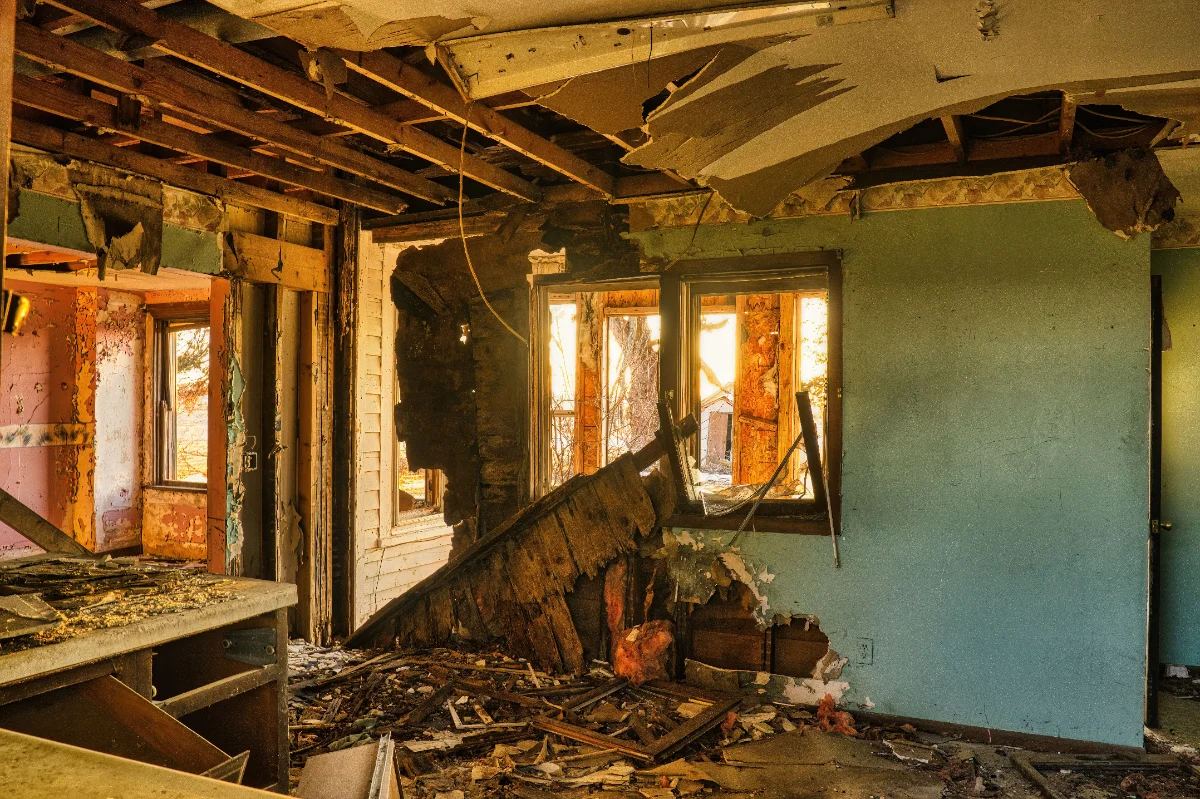
A client near Dinant insures his house in 2015. In 2019 he adds a conservatory and redoes the bathroom. He does not tell his insurer: the policy indexes itself, so he assumes that is enough.
A heating joint fails upstairs. The loss is assessed at 60,000 EUR: floors, ceilings, kitchen. The expert sets the real rebuilding value at 400,000 EUR while the policy insures 285,000. The proportional rule applies and the payout falls to a little over 42,000 EUR.
The cost of updating the insured amount at the time: around 90 EUR of extra premium a year.
- ABEX indexation follows construction costs, not your building work. It never catches up with a conservatory.
- The proportional rule hits small claims too: there is no tolerance threshold.
- A valuation grid on file beats a round figure chosen from memory.
Deductible, loss adjustment, counter-appraisal
The deductible in home insurance is linked to consumer prices and sits around 330 EUR at most insurers. It applies per claim. Some products buy it back, others raise it to lower the premium: it is a trade-off, not a given.
Above a certain loss amount the insurer appoints a loss adjuster. You are entitled to appoint your own: that is the counter-appraisal. Those fees are paid by a full legal expenses policy, not by the fire cover itself. It is something to look at before a claim, not during.
-
01
You call
We take the report, deal with the emergency and tell you what to photograph before cleaning up.
-
02
File opened within 48 hours
Report sent on, covers and insured amounts checked, deductible confirmed.
-
03
The loss adjustment
The insurer appoints an adjuster. You can appoint your own if the figures do not hold up.
-
04
The payout
Often in two stages: an advance on actual value, the balance at replacement value against the repair invoices.
Photograph before you clean up, keep the failed part, throw nothing away. A file without photographs is always argued over longer than a documented one.
And report to your own insurer, even when the cause comes from next door: your insurer pays you, then exercises recourse.
Report a claim →What it costs, and how to compare
Expect roughly 100 to 200 EUR a year for a tenant in a flat, and 300 to 700 EUR a year for the building of a house you own. Add 100 to 200 EUR a year to insure the contents, and 100 to 200 EUR a year more for theft cover. The spread comes from surface area, region, insured amounts and the covers chosen, not from the insurer's brand.
Two policies at the same price can behave very differently on the day of a claim. The six questions that genuinely separate two offers:
-
01
Is the valuation grid on file, and does it bind the insurer?
It is the only real protection against the proportional rule. Ask for it in writing.
-
02
What limits apply to contents and valuables?
Jewellery, IT equipment, bikes, instruments: each item has its ceiling.
-
03
What deductible, and does it apply to every cover?
Indexed amount, application per claim, and whether it can be bought back.
-
04
Replacement value up to what depreciation threshold?
That threshold decides the real payout on a ten or fifteen-year-old item.
-
05
Is theft included, and on what conditions?
Protection measures required, limits, reporting deadline, police report.
-
06
Does the legal expenses cover pay for a counter-appraisal?
Without it, your own expert's fees stay with you.
Keep the home policy and personal liability with the same insurer. Several covers overlap between the two: the student flat, holiday property, damage caused in temporary accommodation. With one insurer, one handler owns the file; with two, each has an interest in passing it back to the other.
We work with more than 40 insurers. See how we work.
Have my policy reviewed →"Bad home insurance files almost never come from an exclusion. They come from an insured amount that never followed the house."
When a client renovates, they call their architect, their builder, their bank. Not their broker. And that is the one call that changes the payout ten years later. A valuation grid updated after building work costs a few tens of euros of premium; forgetting it sometimes costs a quarter of the loss.
Offices in Ciney, Dinant, Eghezée and Brussels. FSMA-registered broker no. 111917.
Ask a question →What people ask us about home cover
Your case is not here? Ask us, we answer within 48 hours.
Ask my question →-
Is home insurance compulsory in Belgium?
−For tenants, yes: the duty to insure tenant liability is written into the Walloon decree of 15 March 2018 for leases signed since 1 September 2018, into the Flemish decree since 1 January 2019 and into the Brussels ordinance of 4 April 2024 since 1 November 2024, which names fire insurance specifically and requires proof of premium payment. For owners no law imposes it: it only becomes compulsory when the bank requires it as a condition of a mortgage.
-
What is the difference between fire insurance and home insurance?
+ -
What is the proportional rule and how do you avoid it?
+ -
What exactly does the natural disasters cover include?
+ -
Are contents indemnified at replacement value?
+ -
Is my child's student flat covered by our policy?
+ -
How much does home insurance cost in Belgium?
+ -
Who pays when water damage comes from the neighbour's flat?
+
Send us your current policy, we will check the insured amount.
We reread the valuation grid, compare covers and limits, and check the deductible. No commitment, and no sales pitch.
Further reading
- Individuals Personal liability The twin policy, often housed inside home cover. →
- Individuals Car & mobility Liability, comprehensive, deductible: the same logic of amounts. →
- Practical Cancelling your insurance Notice, renewal date, mid-term cancellation. →
This page is for information only and does not replace the general conditions, the particular conditions and the insurance product information document (IPID), which are the only contractual documents. The amounts quoted are indicative, index-linked and vary from one insurer to another. The figures in the examples are reconstructed from real files and are not a commitment to compensate. Cinassur is the trade name of Jacis SRL, an insurance broker registered with the FSMA under number 111917.